


Skanda is a God of many attributes, often depicted as six-faced and twelve-armed. Saivite Hindus hail this supreme warrior, the commander-in-chief of the great army of devas, or beings of light, a fearless defender of righteousness. They honor Him as the mystic healer of ailments and the Master of Yoga, guiding those who persevere on enlightenment’s path. Legends say He was the first to renounce the world and step onto the path of kundalini yoga. God Siva bestowed upon His son Skanda dominion over the chakras of willpower, direct cognition, and the purest, child-like divine love. Murugan is the tutelary Deity of the Tamil community.
Who is Kanda?
How is Kanda Sashti Celebrated?
It is considered meritorious to undertake a six-day fast, known as the Skanda Sashti Vrata, or vow, in empathy for Skanda’s titanic struggle. Many abstain from all foods, while some permit themselves fruits and simple, unsalted foods. Following immediately after Diwali, the fast is an ideal antidote to that festival’s feasting, revelry and overindulging. On the day the fast is broken, families enjoy a sweet pudding called payasam along with fried delicacies. A six-part prayer for protection, called the Skanda Sashti Kavacham, is chanted. Six is a number associated with this God. Another discipline is to stand in a river, facing upstream, draw a six-pointed star and write “Saravanabhava,” His supreme mantra, on the water before doing ablutions. Special decorations adorn home shrines, featuring images of the peacock and the fighting rooster. Devotees pilgrimage to Murugan’s temples, especially the temple in Lanham, Maryland, and the seaside sanctuary at Tiruchendur in South India.
What is the Legend of Kanda Sashti?
It is said that eons ago, Skanda fought a powerful asura, or demon, named Surapadman, who embodied the forces of selfishness, ignorance, greed and chaos. Skanda defeated and mastered those lower forces, which He uses, to this day, to the greater good. The subdued demon became his faithful servant, the proud and beautiful peacock on which Skanda rides.
What happens on the Sixth Day?
In Murugan temples, the Deity is worshiped with oblations of special unguents, milk and other offerings. Crowds gather to watch a dramatic play depicting the conquest of Surapadman. Millions flock to see this drama performed on the beaches of Tiruchendur, where the legendary battle occurred.
Six Abodes of Lord Murugan
Arupadaiveedu refers to the six abodes of Lord Murugan showing the six different forms of Murugan pertaining to the six different events that took place in his life. The six abodes are Thiruparankundram, Thiruchendur, Palani, Swamimalai, Thiruthani and Pazhamudircholai. The poet Nakeerar of the Sangam Age has sung many songs in praise of Murugan, and the most well known composition called “Tirumurugartrupadai” describes the six most important abodes of Lord Murugan.
The Six Abodes of Lord Murugan are as follows:
1. Arulmigu Subramaniya Swamy Temple (Thiruparankundram) - Thiruparankunram, Madurai district - Marriage with Deivanai
The Subramaniam temple at Thiruparunkundram is situated six miles south of Madurai. It is a cave-temple located up on a small hill which was built in the 8th century by a king named Maravarman Sundara Pandiyan. Murugan is worshipped as Subramaniyan at the shrine, and this is where he got married to Deivanai, the daughter of Lord Indra.
2. Thiruchendur Murugan Temple (Thirucheeralaivaai) - Thiruchendur, Thoothukudi district - Destroying the asura Surapadman
The main shrine of Murugan is called Senthinathan, and the two Utsava murtis of Thiruchendur Murugan are Jayanthi Nathar and Shanmukhar. Of all the six abodes, this is the only abode located near the seashore. Lord Murugan destroyed the asura Surapadman here, using his Vel(spear) given to him by his mother Parvathi. He also used the Vel in the naazhi kinaru (sacred well) to get water for the people when there was a drought. The Naazhi Kinaru is located south of the temple and devotees use the well water to cleanse themselves prior to worshipping the deity. The Soorasamharam festival is celebrated every year, rejoicing the victory over Surapadman and the asuras by Skanda, combined with the Kandha Shasti festival.
3. Palani Murugan Temple (Thiruvavinankudi) - Pazhani, Dindigul district - Lost the Gnana Pazham
Lord Murugan enshrines as Lord Dandayuthapaani holding a staff (Dandam) in the popular hill temple of Palani. According to ancient mythology, the origin of the temple is based on a story where the sage Naratha presented the fruit of Knowledge (Gnana pazham) to Lord Shiva. Lord Shiva decided to give to one of his sons Ganesh and Muruga, and held a competition between the both of them. The competition was that the fruit would be handed over to the son who first circled the world three times. Murugan immediately took his vahana(vehicle), the peacock, and fled to circle the world. But to Lord Ganesh, the world is his parents and nothing else meant more to him. Hence, he walked around his parents thrice, and won the fruit of Knowledge. When Murugan returned, he found that his elder brother had already won the fruit. Out of sheer disappointment and frustration, he left Kailash and stood atop the Palani Hills.
4. Swamimalai Murugan Temple (Thiruverakam) - Swamimalai, kumbakonam - Preaching the Pranava Mantra “OM”
Lord Murugan is worshipped as Balamurugan and as Swaminatha Swami. The temple is said to be the place where Murugan preached the meaning of the Pranava Mantra “OM” to his father Lord Shiva. Hence this abode is known for its uniqueness, where the son is the teacher and the father is the student. The vahana of Murugan in this abode is an elephant instead of the peacock, and it is believed that the elephant, named Airavatha, was gifted to Murugan by Lord Indra.
5. Thiruthani Murugan Temple (Kundruthoraadal) - Thiruthani, Thiruvallur district - Marriage with Sri Valli
Lord Murugan enshrines in this temple as Tanikaslam. In this abode, he got back his inner peace after the war with the asuras. The name Thiruthani means "blissful repose" and it is here that Lord Muruga met Valli and fell in love with her. The divine marriage between Lord Murugan and Sri Valli took place in this abode. The main festival of the temple is Aadi Karthigai, where thousands of devotees carry kavadees (a wooden structure) on their shoulders. The kavadee is symbolic of burdens going on in one’s life, and devotees pray to the Lord to remove their burdens or sufferings. The devotees cheerfully carry the kavadee, singing devotional songs of Muruga, and dance their way up to the temple.
6. Pazhamudircholai Murugan Temple (Pazhamudircholai) - Pazhamudircholai, Madurai district - Darshan to devotees with both his consorts
Lord Murugan in this shrine is known as Kurinji Nilam Kizhavan, and stands along with his consorts Deivanai and Valli, which makes it the only temple amongst the six abodes where he blesses his devotees along with his consorts. The temple is also known as Solaimalai temple, and stands on the slopes of the Alagar hills, about twelve miles east of Madurai. The temple has three shrines worshipping Lord Ganesha, Lord Murugan with his consorts, and Lord Shiva.
Skanda Sashti Celebration in Thiruchendur
Thiruchendur Murugan Temple The main shrine of Murugan is called Senthinathan, and the two Utsava murtis of Thiruchendur Murugan are Jayanthi Nathar and Shanmukhar. Of all the six abodes, this is the only abode located near the seashore. Lord Murugan destroyed the asura Surapadman here, using his Vel(spear) given to him by his mother Parvathi. He also used the Vel in the naazhi kinaru (sacred well) to get water for the people when there was a drought. The Naazhi Kinaru is located south of the temple and devotees use the well water to cleanse themselves prior to worshiping the deity. The Soorasamharam festival is celebrated every year, rejoicing the victory over Surapadman and the asuras by Skanda, combined with the Kandha Shasti festival.
Tidbits about Kanda Sashti
What else occurs on these holy days? This festival is associated with a unique tradition of giving, dana. A young, unmarried male student, brahmachari, is invited to the home, served a sumptuous meal with special sweets and honored with gifts of new clothing (usually a traditional unstitched cotton veshti), betel leaf, betel nut and fruits. This boy represents the youthful Murugan, and service to one is service to both.
Why does Skanda bear weapons? Hindu iconography is rife with fighting implements. Skanda, general of the heavenly army, wields weapons which symbolize His manifold powers. These battle arms represent forces He uses in the subtle realms of the mind, piercing the veils of ignorance, rescuing those in distress and defending righteousness. He is called the Great Protector.
What does His lance signify? The lance, or vel, embodies discrimination and spiritual insight. It stands for release from ignorance into knowledge, from sinfulness into purity through spiritual austerities.
What is Kavadi Ritual and why is it conducted during Sashti?
Skanda Shashti is a day that is much looked forward to by women as it augurs well for businesses and couples by helping them strengthen their bonds.
A true Murugan devotee, in order to prove his Tapasya to the Lord will truly perform a ritual called Kavadi. This is the toughest rite that a devotee can ever go through to gain the mercy of the Lord. The benefits from offering a Kavadi to the Lord, when compared to the pain he endures while carrying it out, are million times greater.
Devotees, when afflicted by a great crisis in their lives, offer the Lord a Kavadi. The worldly desire is surely fulfilled but it also begins a transformative journey of the soul towards salvation.
The Kavadi has various shapes and sizes, from the simple shape of a hawker's wooden stick to the costly palanquin structure, decoratively woven with flowers and peacock feathers. Kavadi has many brass bells, and the procession is so silent that the bells are the only things that make sounds during a Kavadi procession. There are two baskets containing rice and other items of offerings that hang at either side of the kavadi. These items should be gathered by begging door to door, traveling by foot.
The devotees pour their items into the basket of the Kavadi. Until the prescribed quantity is reached, the devotee keeps begging and then offers it to the lord as the last step. Some people walk the entire distance, sometimes even 100 miles, to the temple of Murugan. The people who donated these are also blessed by God. The Kavadi ritual, from the first to the last step, requires the devotee to follow some restrictions. At the time of starting and ending the Kavadi ritual, he will have to perform a detailed ritual. He has a dress code for this as well. The dress is that of shaivite sadhu, and saffron coloured with a conical red cap, and a cane in his hands that is coated with silver at the ends. This is really Lord Shiva's favorite dress as he is addressed as the ultimate Shaiva sadhu. The person who bears the Kavadi wears Rudraksha malas. Celibacy, abstinence from tamasic food, drinks and drugs are strictly observed. He meditates on Murugan throughout. Many Kavadi bearers self-inflict torturous practices like passing a little spear through their tongue that should come outside from their mouth. Some pierce their cheeks or other parts of the body with this. They grow a beard and eat only a single meal a day. This practice makes him think of God all the time and does not let him speak and improves his endurance to hardship. The Kavadi bearer dances in a 'trance' and you can see a divine glow on his form. He feels oneness with the lord. Sometimes the deity possesses the kavadi bearer. There is yet another seva namely Agni-Kavadi which is the most torturous of all. As the kavadi hangs on his shoulders, the kavadi bearer will have to walk on burning coals along with the background of the drum's chants and agarbattis burning. With all this preparation, the devotee is now ready and in an ecstatic state, and easily walks over the embers or fire and marches towards Murugan idol to offer his seva at his feet.
What is the significance of Carrying Milk Pot for Kanda Sashti?
Carrying milk pots to Murugan temples is an important ritual. The main reason for carrying it is for seeking the blessing of the deity, for desire fulfillment and as part of thanking the deity for fulfilling the desires.
The milk pot symbolizes abundance and fertility.
In this context it must be noted here that the cow itself is a sacred animal in Hinduism and offering its milk to the deity is seen as offering something very pure and auspicious.
Cows are an important part of the agrarian economy. Starting from the Vedic period, cows played an important role in the life of a Hindu. Sharing something so important in one’s life with the deity gives satisfaction to the devotees.
Murugan Festivals
CHITTIRA POURNAMI
between April 14th to May 13th
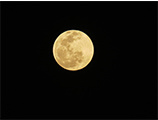
This is a Full moon day festival in the first Tamil month Chittirai (between April 14th to May 13th). Devotees observe fasting, worship God Murugan and break fast the next morning. This light [brilliance of the Poorna Chandra (full moon)] helps dispelling darkness to the souls. So Murugan worship and festival start on this day in the first Tamil month of the Tamil year. Similar celebrations as stated above take place in many Murugan temples.
VAIGASI VISAGAM
May 14th to June 14th
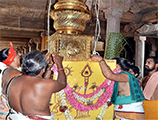
Vaigasi is the second Tamil month in the year (May 14th to June 14th). Vaigasi is the 16th star. Lord Murugan is also called Visagan.
AADI KRITIGAI
16th July to 16th August
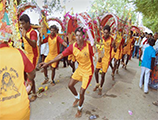
Aadi is the fourth month in the Tamil year (16th July to 16th August). Krithigai is the third star. After pooja and prayer, devotees are provided lunch in the noon.
IPPASI SASHTI
17th October to 15th November
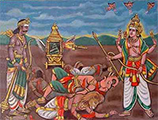
Ippasi is the seventh month in the Tamil year (17th October to 15th November). Sashti is the sixth day after the new moon day (Amavasai Day). It is on this Sashti day the six faced Lord Subramaniyam annihilated Soorabanman the most atrocious Asuran, who imprisoned the Devas, and the Devas were liberated by the Lord. So this festival is celebrated in all Murugan Temples in the world and specially in a very grand manner at Thiruchenthur Temple beside the seaside in Thiruchenthur, Tamil Nadu. Multitude of devotees attend this festival taking place there for seven days, culminating with the sangaram (destruction of all evils) and bestowing of the Lord's grace and blessing to liberated souls.
THIRU KARTHIGAI
16th November to 15th December
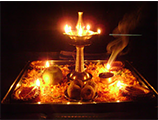
Karthigai is the eighth month in the Tamil year (16th November to 15th December). Thirukarthigai is the third star in the Tamil month. This festival is celebrated in all Murugan Temples all over the world and specially in a very grand manner at Thiru Annamalai Hill Temple in Tamil Nadu. In that evening special Deepa (fire which is called the "sacred thituchudar" in which from Lord Siva appeared in the sky) is placed on the hill top,Braman (God of creation) and Vishnu (Thirumal God of protection) vainly tried to trace the head and foot of that Fire and failed in their efforts. Multitude of devotees including the heads of the scared Mutts of Tamil Nadu which spread spiritualism among people in India and abroad witness this grand festival at Thiruvannamalai and attain the Grace and blessings of Lord Siva. At that night series of small lamps are lit in all Murugan Temples, and Bon Fire (called Sockappan) is lit in the compound of each temple celebrating the victory of the Lord.
THAI PUSAM
14th January to 13th February
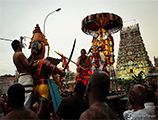
Thai is the tenth month in the Tamil year. (14th January to 13th February). Pusam is the eighth star in the Tamil month. This festival is celebrated in all Murugan temples all over the world and specially in a very grand manner at Palani Hill Temple in Tamil Nadu, Penang Hill and Waterfall Temple at Penang, Batu Caves Temple in Kuala Lumpur, Malaysia and Singapore Temple. In this festival also Lord Subramaniyam comes in procession in silver charriot. Multitude of devotees attend this festival observing fasting and penance and carrying out special prayers, offering Abishega materials, garlands, fruits etc to Lord Subramaniyam and carrying Kavadies in their shoulders, to the Lord up the hill to obtain the Lord's Grace and blessings and become cured of their disabilities, ill health, diseases, troubles etc.
PANGUNI UTHIRAM
14th March to 13th April
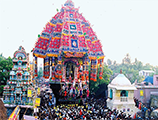
Panguni Uthiram is the holy festival for Hindus. This day falls on Panguni month (Palguni month in Sanskrit) is the last month of Tamil month calendar. Panguni Uthiram defined as Panguni month, Uthiram -natchathiram (star), Uthiram natchathiram coincides with the full moon on this day. Panguni Uthiram happens in full moon day of Panguni month (mid March – mid-April). Panguni Uthiram is an auspicious day because many divine marriages happened on Panguni Uthiram. Particularly, many devotees are celebrating Murugan on Panguni Uthiram. They used to go Murugan temple and take vratham during Panguni Uthiram.
